


THE ACES OF CRIME - Part Three

Fantômas: When Identity Became the Crime
The Aces of Crime is a series exploring the enduring appeal of criminal masterminds in fiction and culture.
If Professor Moriarty represents the unseen criminal orchestrator, then Fantômas represents something far more unsettling: the idea that someone's identity itself cannot be trusted.

Created in 1911 by the French writers Marcel Allain and Pierre Souvestre, Fantômas appeared in a series of wildly popular pulp novels produced at astonishing speed. Allain and Souvestre wrote thirty-two novels together, followed by a further eleven written by Allain after Souvestre's death.
Perhaps in response to the so-called Era of Attacks — the anarchist campaign in France during the 1890s which saw a series of bombings and political assassinations — the authors chose to make Fantômas a force of anarchic chaos: a ruthless psychopath who had no qualms about killing in all manner of ingenious and sadistic ways.
This Ace of Crime shows no mercy, and is loyal to no one, not even his own children. In this way, he foreshadows the modern concept of the serial killer — a figure whose crimes are defined by repetition, methodical technique and an impenetrable psychology.
But violence is not Fantômas's most unsettling characteristic. His greatest weapon is identity itself.
The Man Who Could Be Anyone
Fantômas is a master of disguise, always appearing under an assumed identity, and often that of a person whom he has just murdered. But these disguises are more than a mask or costume. He commits himself completely to the transformation, assuming the personality as convincingly as the clothes.
Because Fantômas doesn't simply hide behind a false identity, but becomes someone else, the real man behind the disguise becomes almost impossible to grasp.
One of the characters in the opening chapter of the first Fantômas novel attempts to describe the problem:
“It is impossible to say exactly or to know precisely who Fantômas is. He often assumes the form and personality of some definite and even well-known individual; sometimes he assumes the form of two human beings at one and the same time… That he is a living person is certain and undeniable, yet he is impossible to catch or to identify. He is nowhere and everywhere at once, his shadow hovers above the strangest mysteries, and his traces are found near the most inexplicable crimes.”
It is a remarkably modern concept; if you cannot establish who your enemy actually is, how can you possibly know where to hunt him down?
From Anarchist to Serial Killer
The real-world background to Fantômas is interesting.
France in the 1890s experienced a wave of anarchist violence that became known as the Era of Attacks. Bombings and assassinations created a new kind of public fear: violence that could emerge apparently without warning from within an otherwise ordinary urban environment.

One of the most notorious figures associated with this period was François Ravachol, who became known as the "Christ of Anarchy".
Ravachol became infamous for bombings and assassinations of authority figures in France and has been credited as one of the architects of the Era of Attacks. What terrified the public was not simply the violence of his crimes, but the ideological extremism behind them.
These unpredictable attacks — often carried out in highly populated urban spaces — became, in a way, a template for modern terrorism. Ravachol himself has subsequently been reinterpreted in very different ways — at times as a kind of vigilante acting in defence of the proletariat, and at others as a ruthless and amoral criminal.
Fantômas conveys something of the same atmosphere of frightening unpredictability. But with the political context removed, what remains is something even more frightening: violence without an obvious motive.
Fantômas Goes to the Cinema

Fantômas was quickly adapted for the new medium of cinema in a celebrated series of silent films directed by Louis Feuillade.
In France, at the height of his popularity, Fantômas was not simply a fictional villain but a cultural obsession — an embodiment of modern urban anxiety in a rapidly changing world.
By the 1920s he had transcended the confines of crime fiction to find a new set of admirers within the avant-garde. The Surrealists, in particular, were fascinated by him.
For artists such as René Magritte, Fantômas represented the fluidity of reality and the thrill of discovering the uncanny within everyday life. He appeared in Surrealist painting, photography, collage and writing as a kind of anti-hero of modernity: someone who exposed how easily reality could be remodelled.

Magritte's 1927 painting Le Barbare, for example, features the head of our Ace of Crime emerging through a brick wall. And his The Menaced Assassin — shown here — borrows directly from a scene in Louis Feuillade’s 1913 silent Fantômas film Le Mort Qui Tue (The Dead Man Who Killed).
Fantômas had begun life as a murderous criminal, but the Surrealists saw something else in him: a character who demonstrated that the world might not be quite as stable or comprehensible as it appeared. In that sense, he begins to foreshadow something that would become increasingly culturally important in the twenty-first century — the unsettling fluidity of identity itself.
From Greasepaint to Latex
The character continued to evolve through the twentieth century.
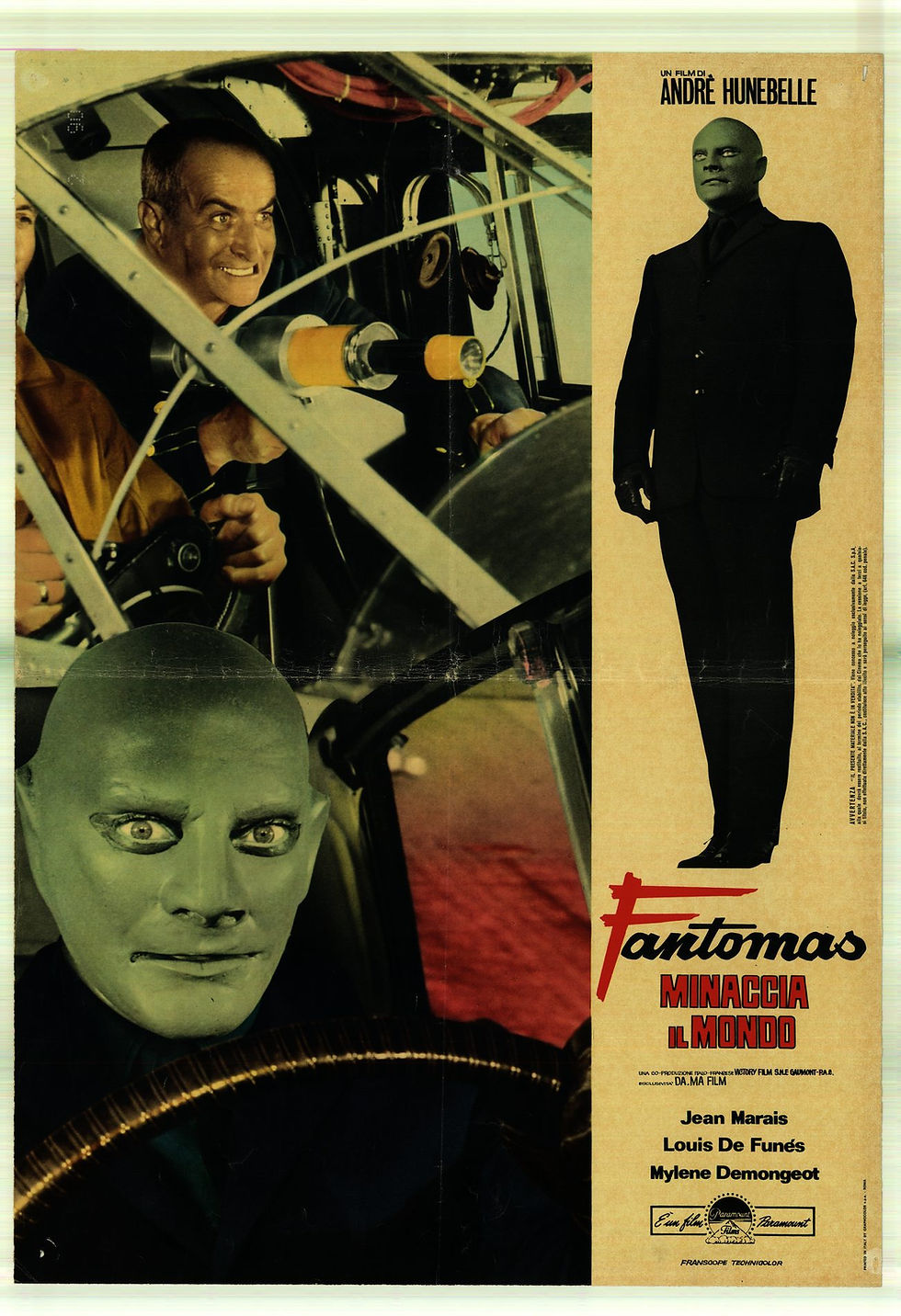
In the 1960s film adaptations starring Jean Marais, Fantômas acquired new tools of deception. Marais — who, in an oblique link to the Surrealist connection, had once been the lover and muse of Jean Cocteau — played a villain who no longer relied solely on greasepaint and theatrical performance. Instead, this Fantômas employed realistic latex masks and scientific gadgetry to impersonate others with uncanny precision.
What had once been purely theatrical mimicry had now become technological.
This has particular resonance today. Deepfake video, cloned voices and AI-generated identities are increasingly capable of producing convincing simulations of real people. The technology may have changed, but the underlying fear has not. How do we know that the person we are speaking to — or emailing/texting — is really who they appear to be?
The Modern Fantômas
Unlike Professor Moriarty, Fantômas is a criminal mastermind who has chosen to hide in plain sight. He is not simply concealing his whereabouts; he is disrupting the very notion of identity itself.
In that sense, he is not merely a precursor to the modern serial killer. He also anticipates the criminals of the contemporary digital world: a place in which we can no longer be certain of who we are interacting with.
The modern Fantômas no longer requires greasepaint or latex masks to deceive us. Instead, he can slip seamlessly into the streams of data that surround and shape our everyday lives.
And there is something particularly appropriate about the fact that Fantômas has survived so successfully into the digital age. Moriarty's world was one of networks. Fantômas's is one of identities. The Victorian criminal mastermind taught us to fear the unseen intelligence behind events. Fantômas taught us to fear something different: that the person behind the face might not exist at all.
More than a century after Allain and Souvestre created him, that still seems like a particularly uncomfortable thought.
And if Fantômas makes us question who we are dealing with, the next Ace of Crime asks an even more disturbing question:
What if someone could control what we think?
Next time, in Part Four: Dr Mabuse: The Mastermind Who Learned to Control Minds, we'll meet the criminal genius who moved beyond controlling networks and identities to something far more disturbing: the manipulation of thoughts, perception and belief.
Enjoyed this article?
The Aces of Crime is an ongoing series exploring the enduring appeal of criminal masterminds in fiction and culture. If you'd like to learn more about my research and writing, visit the About page. You can also discover my Piccadilly Noir novels, Midnight Streets and The Devil's Banquet, which bring the darker streets of interwar London to life. Watch for the next instalment of The Aces of Crime, where we'll continue exploring the villains, ideas and myths that have shaped crime fiction for more than a century.


Comments